
The HR Decisions That Seem Small — And Aren't

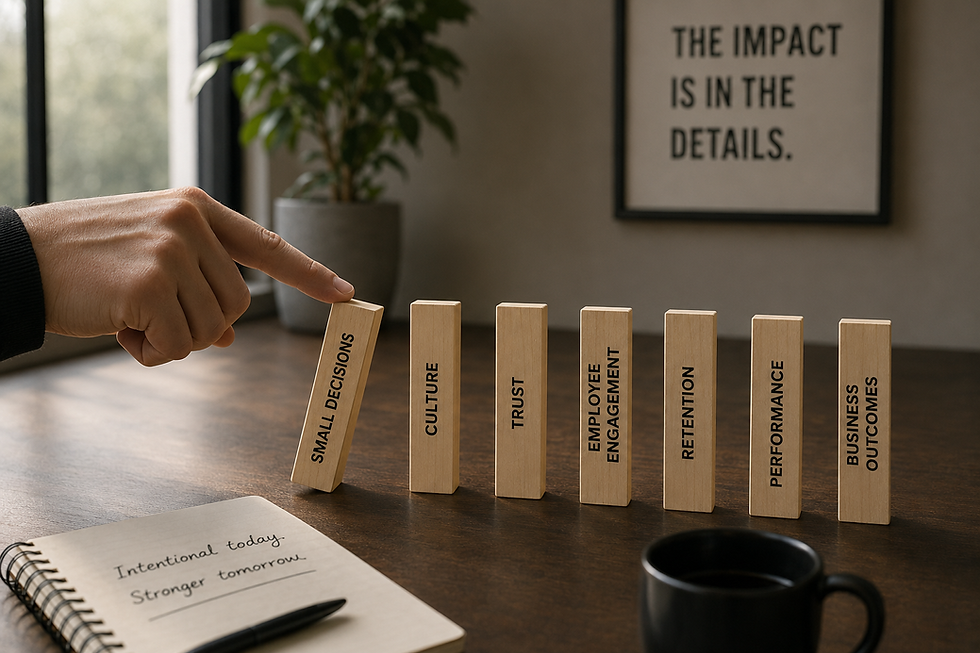
Some of the most consequential decisions in a business do not feel consequential when they are made.
They feel routine.
They feel like something to handle quickly and move on from.
And because they do not trigger alarm bells in the moment, they often do not get the attention they deserve — until the impact shows up somewhere else entirely.
The Decisions That Fall Through the Cracks
There is a category of HR decisions that most small and mid-sized businesses underestimate.
Not the big ones — the terminations, the restructures, the policy overhauls. Those get scrutiny.
The ones that slip by are smaller.
Promoting someone into a leadership role because they were the best individual contributor, without asking whether they are ready to lead people
Letting a compensation discrepancy sit unaddressed because the conversation feels awkward
Onboarding a new hire without a real plan and assuming they will figure it out
Allowing a behavioral issue to go undocumented because the person is otherwise valuable
Saying yes to a flexible arrangement for one employee without thinking through what that means for everyone else
None of these feel like major decisions in the moment.
Each of them can create significant problems over time.
Why Small Decisions Compound
The reason these decisions matter more than they appear to be that people are paying attention — even when you think they are not.
Employees notice who gets promoted and why.
They notice when someone's behavior is tolerated differently than their own would be.
They notice when a new hire is set up to succeed versus left to sink or swim.
They draw conclusions from those observations about what is valued here, how decisions get made, and whether the organization's stated values match its actual behavior.
When small decisions are made carelessly or inconsistently, trust erodes — quietly, gradually, and often invisibly until it is already gone.
Consistency Is the Foundation
One of the most important things HR strategy does for a growing business is create consistency.
Not rigidity. Consistency.
It means that decisions about people are made with the same care and intentionality regardless of who is involved or how busy things are.
It means that a manager in one department is applying the same standards as a manager in another.
It means that employees can trust that the rules are the rules — not suggestions that bend depending on who is asking.
That consistency does not happen by accident. It requires someone paying attention to the pattern of decisions being made across the organization, not just the individual moments.
The Compounding Cost of Getting It Wrong
A bad hire who was rushed through the process costs time, money, and team morale.
A promotion that was not thought through carefully can damage a high-performing team for months.
A compensation issue that sat too long can turn into a legal risk or a resignation that blindsides everyone.
These are not hypothetical outcomes. They are the predictable result of treating people decisions as lower stakes than they actually are.
What Intentional HR Strategy Looks Like in Practice
It does not require a large HR department.
It requires someone whose job it is to think through the people implications of business decisions — before they are made, not after.
Before promoting someone: Is this person ready? What support will they need? What happens to the team dynamic?
Before making a compensation decision: Is this consistent? What precedent does it set?
Before onboarding a new hire: What does success look like in their first 90 days, and who is responsible for getting them there?
These are not complicated questions. But they are questions that someone needs to be asking — consistently, and early enough to matter.
Final Thought
The businesses that get people strategy right are not necessarily the ones with the biggest HR budgets.
They are the ones that take the small decisions seriously.
They understand that culture, trust, and retention are not built in single dramatic moments.
They are built — or quietly eroded — one small decision at a time.


Comments